February 2026
Rethinking kindergarten

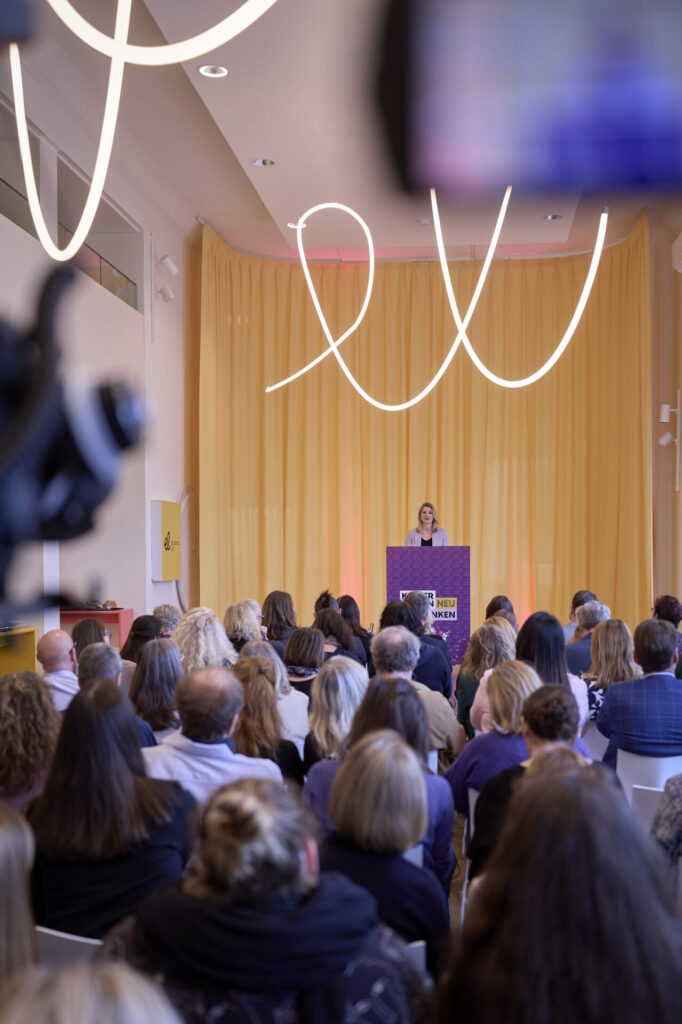
In January, Bettina Emmerling, Deputy Mayor and City Councillor for Education of the City of Vienna, gave her keynote speech “Rethinking Kindergarten” at the Education Lab. For us, this event was more than just a program item: it was a strong signal that the Education Lab is perceived as an open place for exchange, joint further thinking and innovation in the education sector.
Following the speech, we sent out a survey to the participants, which included several practical assessment questions as well as an open question. Our main aim was to gather feedback from everyday life, pick up on the impulses from the speech and better understand where the participants currently see the greatest need for improvement. In this way, voices from different perspectives became visible and it became clear where the greatest need for action is currently seen.
Who took part and from what perspective?
(Specific question: Your perspective: From which perspective are you answering this survey?)
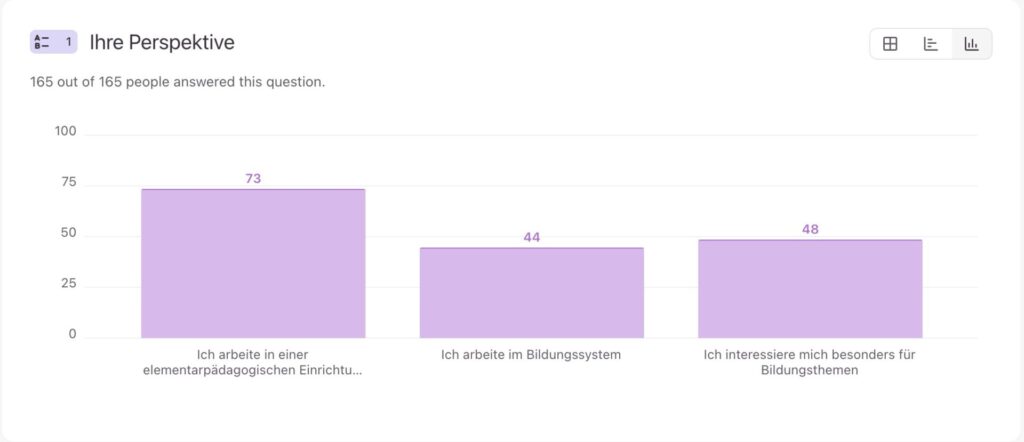
More than 160 people took part in the survey and their feedback reflects a broad spectrum of perspectives:
- a large proportion from elementary educational institutions,
- around a third from the education system as a whole,
- as well as people who deal intensively with educational topics, whom we in the Education Lab see as educational designers.
This diversity was particularly important to us because sustainable further development can only be achieved by bringing together different experiences, perspectives and points of view.
How is the status quo assessed?
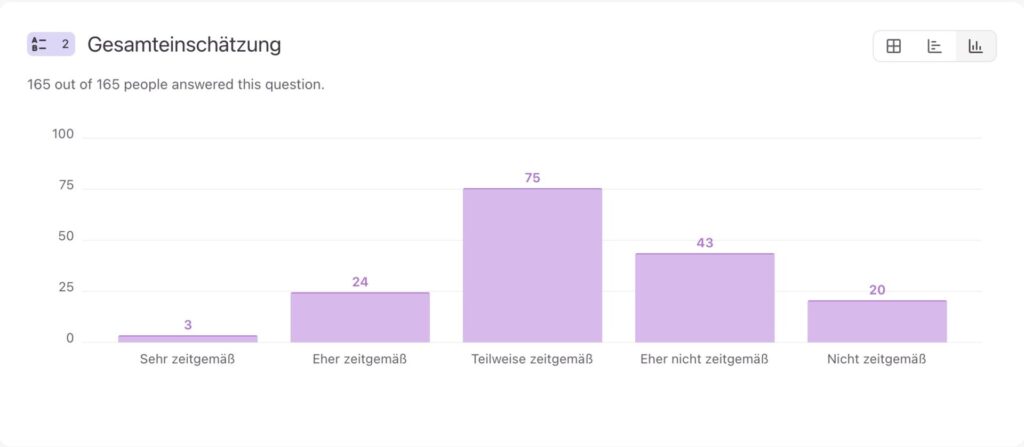
(Specific question: Overall assessment: In your opinion, is elementary education in Vienna up to date?)
Elementary education in Vienna is predominantly perceived as partially up-to-date (around 45% of respondents). At the same time, it is clear that more than a third (around 38%) see it as not at all or not up to date. Only around 16% rate it as (very) up-to-date.
This underlines the fact that reform discussions are not abstract, but are linked to real experiences in everyday life. In the Education Lab, we see this as an invitation to bring together precisely these perspectives and translate them into dialog.
Where the greatest need for development is seen
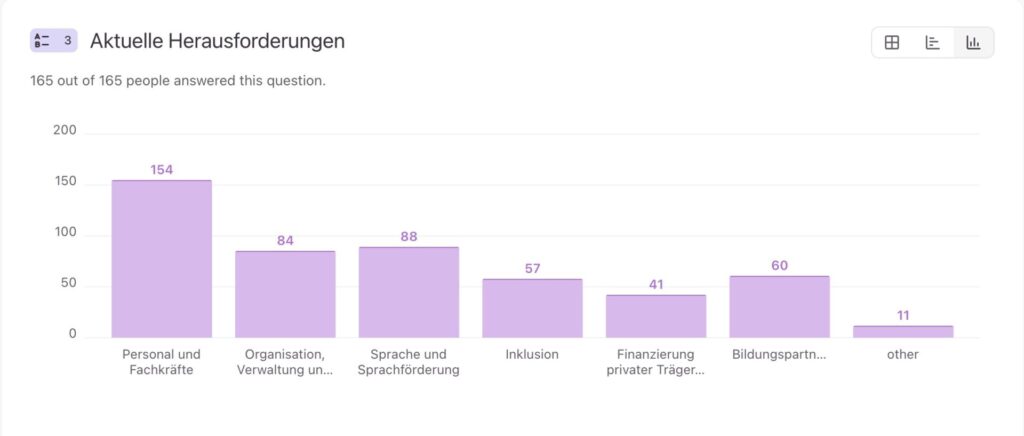
(Specific question: Current challenges: Where do you currently see the greatest need for development in the system of elementary education? Multiple answers possible).
Clear priorities emerge across all groups:
- Staff and specialists (over 90 % of participants),
- Language and language support (around 53%),
- organization as well as administrative and process issues (around 50 % each),
- Cooperation with parents and educational partnership (around 36%).
These issues are not new, but the clarity with which they are mentioned shows how urgently concrete improvements are needed.
What would make everyday working life noticeably easier
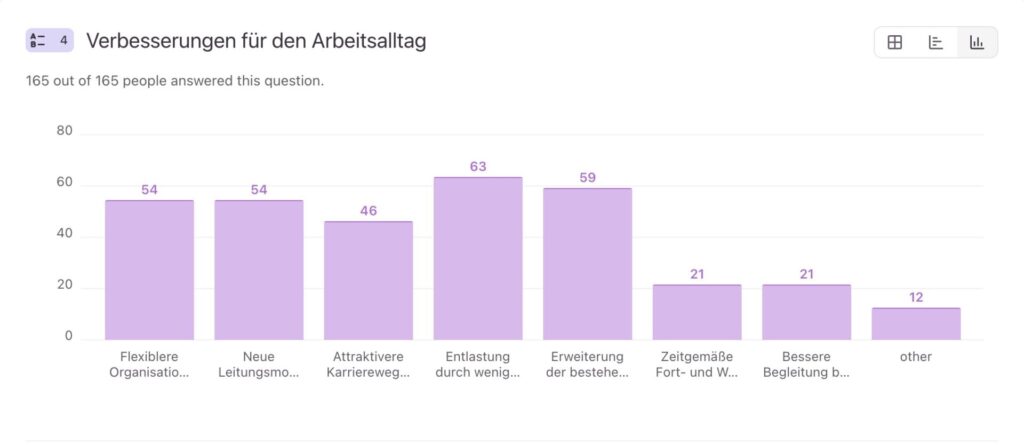
(Specific question: Improvements for everyday working life: Which of the following measures would make everyday working life in early childhood education facilities most easier? Multiple answers possible).
The picture is also consistent for the proposed measures:
- Relief through less bureaucracy,
- multi-professional teams and expanded job profiles,
- more flexible organizational and care models,
- Clear management models with separation of pedagogy and administration,
- attractive development and career paths.
This is less about individual measures and more about structural framework conditions that enable quality and retain specialists in the system.
The open question: what would really change
(Specific question: An open question: Your most important change: If you had the opportunity to change one thing in order to noticeably strengthen elementary education in Vienna, what would it be?)
Three main concerns were repeated in the free responses: more staff, better childcare ratios and a higher social status for early childhood education.
This feedback makes it clear that, from the point of view of practitioners, reforms only work if they are associated with sufficient resources, recognition and tangible relief.
What this means for our work in the Education Lab
For us as an Education Lab, these results are both a confirmation and a mission. Confirmation because it shows that we need spaces in which practice, politics, administration and educational initiatives can enter into discussions at eye level, beyond existing affiliations, routines or institutional logics. This is exactly what the Education Lab was created for.
mission, because we are further sharpening our role in it:
- as a place that brings together different perspectives,
- as a space for joint thinking and concrete further development,
- as an opportunity to make good practice visible, share it and pass it on.
We see the fact that the Deputy Mayor and City Councillor for Education deliberately held her keynote speech here as an appreciation of this role and as an invitation to continue this dialog.
The survey clearly shows that many of the challenges mentioned cannot be solved “from above”. They need exchange, pilot projects, new forms of collaboration and places where people can work together on solutions. This is precisely where we see our task in the Education Lab, today and in the future.
The results can also be found here.
Informed
stay
Everything is in motion with us! Our newsletter will keep you up to date with new offers and exciting events. Sign up so you don’t miss anything!