June 2026
Basic Skills or Future Skills? Why “both” Isn’t Enough of an Answer
Future skills are currently a major topic in many educational debates. Creativity, critical thinking, and collaboration are considered key competencies for a changing world.
At the same time, national and international findings show that many children and adolescents do not sufficiently master basic skills in reading, writing, and mathematics. PISA 2022 revealed significant declines in mathematics and reading across the OECD average; moreover, students from socioeconomically disadvantaged backgrounds are significantly less likely to achieve basic mathematical proficiency.
The 2024 Austrian National Education Report also points to the persistence of social selectivity: Children from socially disadvantaged and educationally marginalized families are overrepresented among low-performing students (OECD, 2023; BMBWF, 2024).
Our most recent Education Lab Deep Dive also addressed this tension: Core Competencies or Future Skills—Where Do We Start?
The answer “both” seems obvious. At the same time, it doesn’t really help much. After all, schools and preschools have neither unlimited time nor unlimited resources. The real question, therefore, is: What do we prioritize? And why?
Such prioritization is not merely a technical matter. It begins with clarifying what education is meant to achieve. For me, the answer is this: Education should empower people to shape their own lives, to participate in their communities and society, and to help shape them responsibly.
From this perspective, basic competencies and future skills serve different functions.
Basic skills create choices. Future skills help us make good decisions based on those choices.
These choices are not meant to be purely individual. They pertain to one’s own life as well as to life in community: in preschool/school, family, work, democracy, and society.
Anyone who doesn’t read for comprehension may find themselves reaching their limits sooner: when learning, when understanding information, when making sense of political debates, when filling out a form, when exercising their own rights. Anyone who mathematical relationships Those who do not understand this find it more difficult to evaluate social, economic, and scientific issues. Those who Those who cannot express themselves tends to be heard less.
Future Skills in turn, help students make good and responsible use of the opportunities this creates: thinking critically, solving problems, taking responsibility, dealing with uncertainty, and collaborating with others. These are thus competencies for their own educational and life journeys and for living together in a democratic society. The OECD Learning Compass 2030 describes precisely this combination of knowledge, skills, attitudes, and values—as well as student agency and individual and collective well-being—as a guide for education in an unpredictable future. (OECD, n.d.)
The relevant question, therefore, is: How do basic competencies and future skills interact? And Which competencies build on which ones?


Before we set priorities, we should talk about learning
When we talk about competencies, we’re usually talking about the What. We talk about the How: How do competencies actually develop? What learning processes enable knowledge to be not only reproduced in the short term, but also understood and applied in the long term?
That’s why our Deep Dive began with an overview of cognitive learning research. Drawing on research into learning and memory, the cognitive scientists at MindThings demonstrated that effective learning often works differently than we intuitively assume.
The view of Retrieval Practice. Studies by Roediger and Karpicke show that learners who actively retrieve information from their memory—for example, through regular quizzes—achieve better long-term learning outcomes than learners who simply reread the material. At the same time, they often rate their own performance more poorly. Effective learning, therefore, does not always feel effective. (Roediger & Karpicke, 2006)
This is central to debates about education. Many learning strategies that feel good are not automatically effective. Rereading, highlighting, or intensive practice on a single topic can create a sense of familiarity that is easily mistaken for mastery. Brown, Roediger, and McDaniel describe this effect in Make It Stick as an illusion of mastery: You feel confident because something seems familiar, not because you can recall and apply it over the long term (Brown et al., 2014).
This also makes the discussion about core competencies and future skills more precise. It is not enough to say that children should learn more math. Nor is it enough to say that children should work more independently. In both cases, we must ask: Which learning processes actually facilitate the development of competencies?
Cognitive learning research does not provide a simple hierarchy here, but it does offer an important design principle: The less prior knowledge, routines, and strategies learners have in a given area, the more tasks must be structured, guided, and simplified. Complex tasks can deepen learning if the necessary subskills are developed (Kirschner et al., 2006).


Basic skills are a matter of educational equity
It became clear during the discussion that basic skills, in particular, are a central issue in educational equity.
The term was used in various ways throughout the evening. In addition to reading, writing, and math, the ability to ask good questions was also mentioned. It is precisely this diversity that shows that “basic skills” is not a self-explanatory term. We often use it without agreeing on a common definition.
For me, this primarily involves three things: mathematical understanding, reading comprehension, and the ability to express oneself both orally and in writing.
These skills are not at odds with creativity or critical thinking. They are often their Requirement. To think critically, one needs knowledge that can be subjected to criticism. To solve problems, one needs an understanding of how things are connected. To ask good questions, one needs language, concepts, and prior knowledge.
In Make It Stick there is a sentence to that effect that sums up the debate well: You cannot apply knowledge in practice if you do not have knowledge to apply (Brown et al., 2014).
That sounds simple. But it’s crucial to the debate on education. After all, a lack of basic skills limits many future choices. So it’s not just about better performance in school subjects. It’s all about participation.
Future skills don’t just happen on their own
This does not amount to a mere “back-to-basics” debate. Young people need the ability to cope with uncertainty, analyze problems, work in teams, take on responsibility, and shape the future. That is precisely why these skills play a major role in international competency models. In its Future of Education and Skills project, the OECD emphasizes that, in addition to knowledge and skills, students also need attitudes and values to cope with an unpredictable future and to help shape it responsibly. (OECD, n.d.)
But the key point is: Future skills do not develop automatically simply because the form of learning changes.
Open learning is not the same as self-organization. Group work does not automatically mean collaboration. Project work does not automatically lead to problem-solving skills.
Methods and skills are often conflated in debates about educational innovation. An open learning environment can be very effective if it is well designed. However, it can also be overwhelming if students do not receive the necessary strategies, routines, and feedback.
Future Skills also need scaffolding. They need explicit guidance, practice, feedback, and reflection. Self-organization must be learned. Collaboration must be learned. Critical thinking must be learned.

The real question is one of prioritization
In the end, many agreed: We need both. Core competencies and future skills. Knowledge and application. Structure and freedom.
But that’s exactly where the real work begins.
After all, “both” does not answer the question of what takes priority in everyday life when time, staff, and attention are limited. It does not answer what every child must be able to do and where individual focus begins. It does not answer which competencies are universally necessary and which depend more on interests, talents, or life paths.
This question is central to any education system: What skills must everyone have in order to have choices and participate in society? And what do they need to make good and responsible use of these opportunities, both for themselves and in relation to others?
This shifts the focus of the debate. It is less about ranking competencies and more about how they relate to one another.
For an education system, this means that basic competencies must be systematically ensured, because they open up opportunities for choice and participation. However, future skills should not be treated as a competing, separate program, but rather developed within learning environments that build on these foundations while also applying them in meaningful ways.
Why We Need Different Formats for Discourse
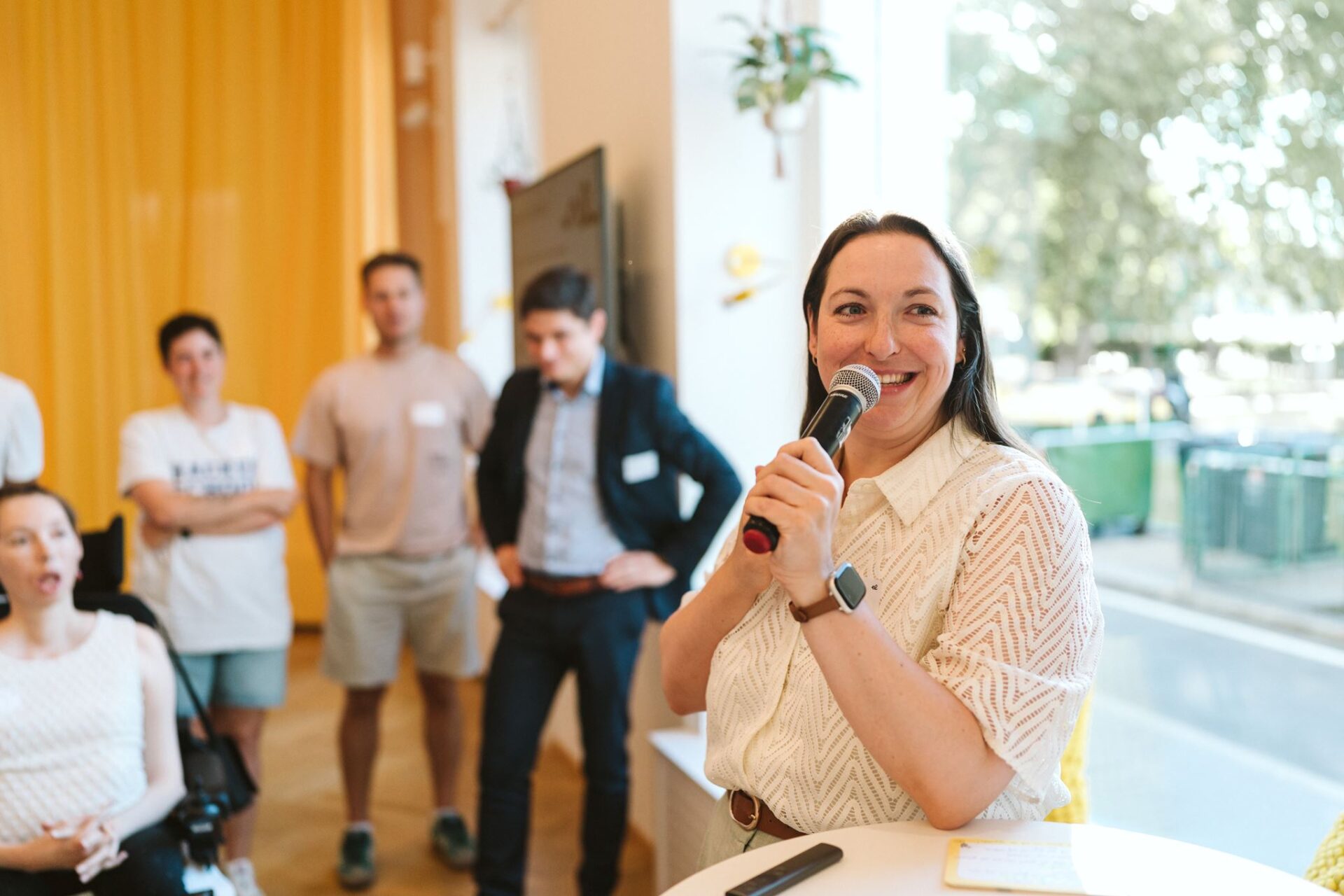
The Deep Dive was deliberately not structured as a traditional panel discussion. The format was designed to bring together different perspectives from the professional world, academia, politics, government, and society in order to jointly explore an area of tension.
That is why the participants had to take a stance at the beginning. Staying in the middle was not allowed. This was followed by brief prompts and recurring periods of reflection and discussion: THINK, PAIR, SHARE. First reflect on your own, then discuss in pairs, and finally share your thoughts with the larger group. Many formats in education consist of input, reactions, and quick comments. Those who think quickly and enjoy speaking tend to dominate the room. Those who need time to organize their thoughts often don’t get a chance to speak.
THINK Time is therefore not just a methodological gimmick. It makes it possible to Get more people to think along with us—not just those who respond the fastest.
Be more precise
A debate like this loses its edge if it gets stuck at “either/or.” But it also loses its edge if it ends with “both.”
The next step is precision: in our terminology, in our organizational structure, in the evidence we use to guide our learning, and in the priorities we must set despite our limited time.
Perhaps that is precisely the purpose of educational innovation: not to constantly come up with new terms, but to make better decisions possible.
Basic skills create choices. Future skills help us make good decisions based on those choices.
Educational work lies in the space in between: in conscious development, in thoughtful application, and in the question of what we want to reliably provide for all children—both for their own lives and for living together in a democratic society.
About the Author: Julia Pichler is the executive director of the Education Lab and an adjunct lecturer at the Vienna University of Teacher Education. She holds a degree in Education Policy and Analysis from the Harvard Graduate School of Education and taught for several years herself through Teach For Austria. Her work focuses on educational equity, learning research, and the question of how evidence-based educational innovation can be successfully implemented in collaboration with educators.
Sources
Brown, P. C., Roediger, H. L. III, & McDaniel, M. A. (2014). Make It Stick: The Science of Successful Learning. Belknap Press, a division of Harvard University Press.
Federal Ministry of Education, Science, and Research (BMBWF). (2024). Austria’s National Education Report 2024: Executive Summary. Vienna: BMBWF. https://www.bmb.gv.at/dam/jcr%3Aa8cbbdc8-0757-49c0-ad5a-3d80724dd143/nbb2024_exsum.pdf
Kirschner, P. A., Sweller, J., & Clark, R. E. (2006). Why minimal guidance during instruction does not work: An analysis of the failure of constructivist, discovery, problem-based, experiential, and inquiry-based teaching. Educational Psychologist, 41(2), 75–86. https://doi.org/10.1207/s15326985ep4102_1
OECD. (2023). PISA 2022 Results (Volume I): The State of Learning and Equity in Education. Paris: OECD Publishing. https://doi.org/10.1787/53f23881-en
OECD. (n.d.). The Future of Education and Skills 2030/2040. Retrieved on June 29, 2026, from https://www.oecd.org/en/about/projects/future-of-education-and-skills-2030.html
Roediger, H. L. III, & Karpicke, J. D. (2006). Test-enhanced learning: Taking memory tests improves long-term retention. Psychological Science, 17(3), 249–255. https://doi.org/10.1111/j.1467-9280.2006.01693.x
Stay informed
We’re always on the move! Sign up for our newsletter to stay up to date on new offers and exciting events. Sign up so you don’t miss a thing!