September 2026
How Europe Wins: Turning Collective Intelligence into a Shared Direction
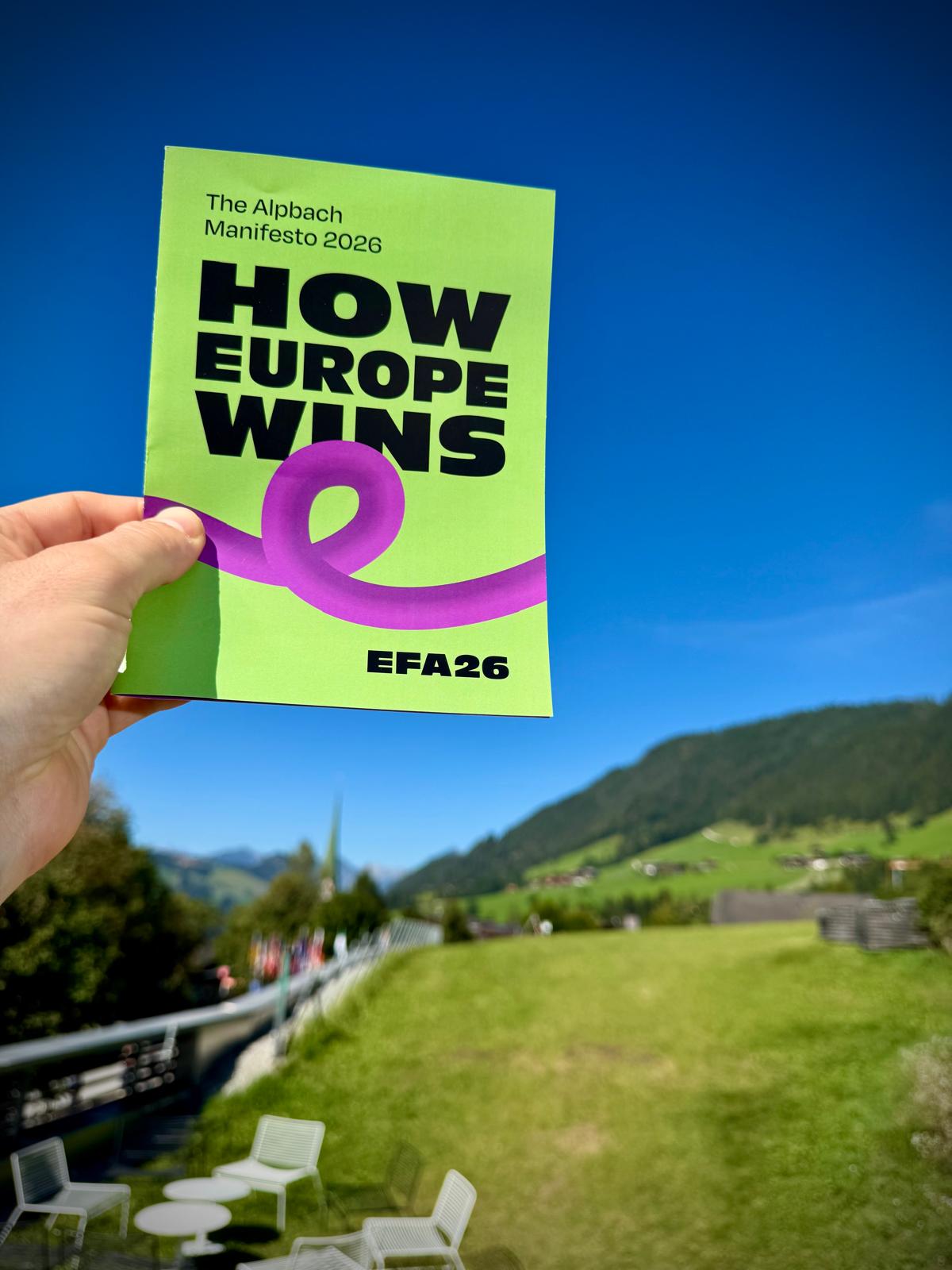
As a Solution Partner to the European Forum Alpbach 2026, we used an AI-assisted, participatory process to develop four proposals for how Europe can succeed over the next decade.
Europe is not short of ideas. At conferences, in media debates, and in policy discussions, thousands of people are analyzing the challenges facing the continent. What is often missing is the infrastructure to connect these insights, preserve important disagreements, and translate collective intelligence into a shared direction.
This was the challenge at the heart of our contribution as a Solution Partner to the European Forum Alpbach 2026.
Under the overarching question of“How Europe Wins,”we developed an AI-assisted process that “listened” to the Forum as it unfolded. It brought together the knowledge generated across its various formats and invited participants to build on it further. The aim was not simply to summarize what had been said, but to identify the changes Europe must make, the difficult trade-offs it must navigate, and a shared vision of what success could look like by 2035.
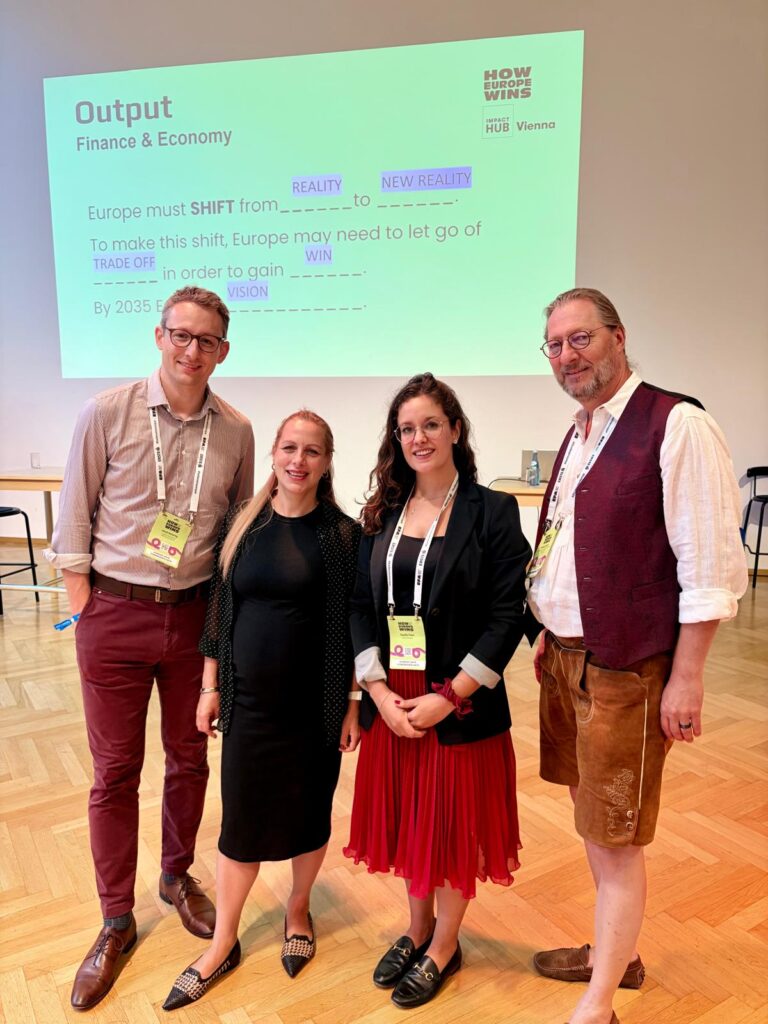
The process was led by Alexis Eremia, co-founder of Impact Hub Vienna. Alexis and I facilitated the four Solution Hours, while our wonderful team members— Itai Gruenbaum, Raphaela Stock, and Sophia Riedl —accompanied and supported the process throughout its development and delivery.
Listening to the Forum as it Unfolded
We wanted the four Solution Hours to start with the ideas and evidence already being generated at the Forum rather than starting from scratch.
To make this possible, we built an AI synthesis agent with a deliberately closed-source base. It drew exclusively on material created at the 2026 European Forum Alpbach: recordings and transcripts of sessions and panel discussions, written reports from the Labs, essays and reflections by scholarship recipients, speakers’ contributions, and content published on the Forum’s website.
Nothing from outside the Forum was added. This restriction was fundamental to the concept. The purpose of the agent was not to introduce another external perspective. It was to help us listen to the Forum itself, connect insights from across its different spaces, and make its collective knowledge accessible for the next stage of the process.
For each of the Forum’s four strategic themes— Security, Finance, Climate, and Democracy —the AI agent supported our editorial team in producing a real-time briefing. Each briefing incorporated the information available up to that point and focused on three dimensions:
- The current logic: The assumptions, incentives, structures, and institutional practices that currently shape the respective field.
- The pressures for change: The political, economic, technological, environmental, social, and geopolitical forces that are making the current approach increasingly inadequate.
- The emerging questions and tensions: The contradictions, disagreements, and missing perspectives already evident throughout the Forum.
The briefings were not designed to predetermine the conclusions. They were intended to spark discussion, allow for disagreement, and provide participants with a concrete, evidence-based starting point that they could interpret, challenge, and build upon.
From a Shared Understanding to a Collective Direction
From Monday through Thursday of the Forum’s Conference Week, we hosted one Solution Hour each day, with each session dedicated to one of the four themes.
The AI-supported briefing and presentations by two to three expert speakers outlined the current rationale and the pressures for change. The participants then took over.
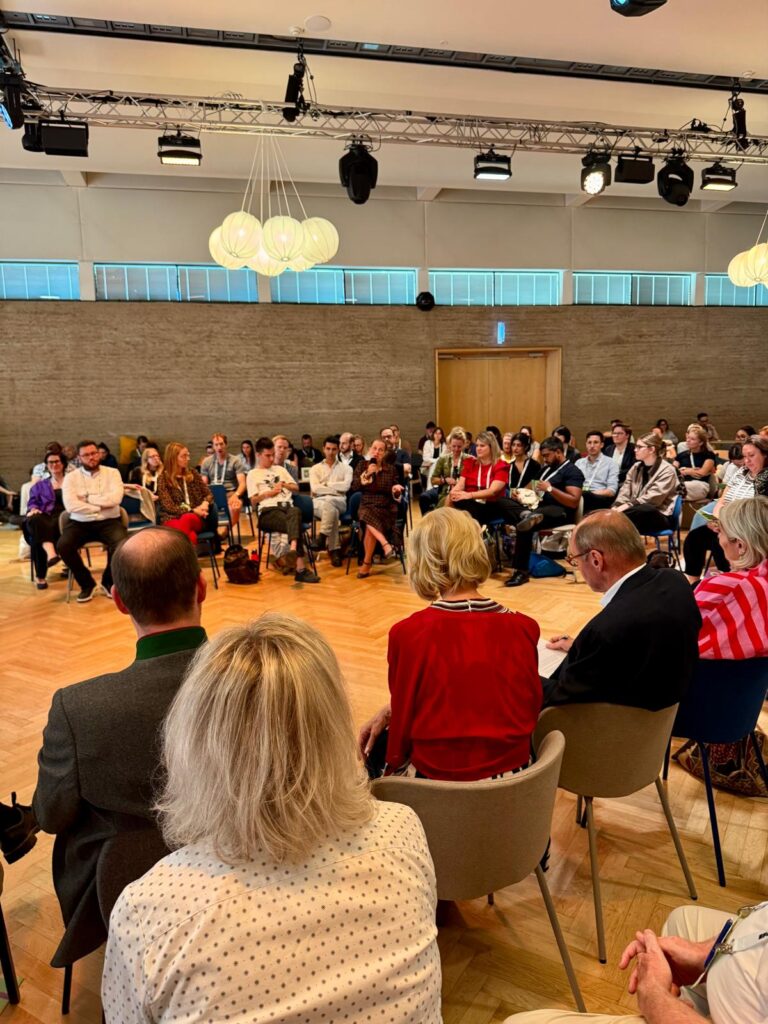
Over the course of the four sessions, approximately 140 participants from diverse and international backgrounds worked in about 30 groups. Each group went through the following three stages.
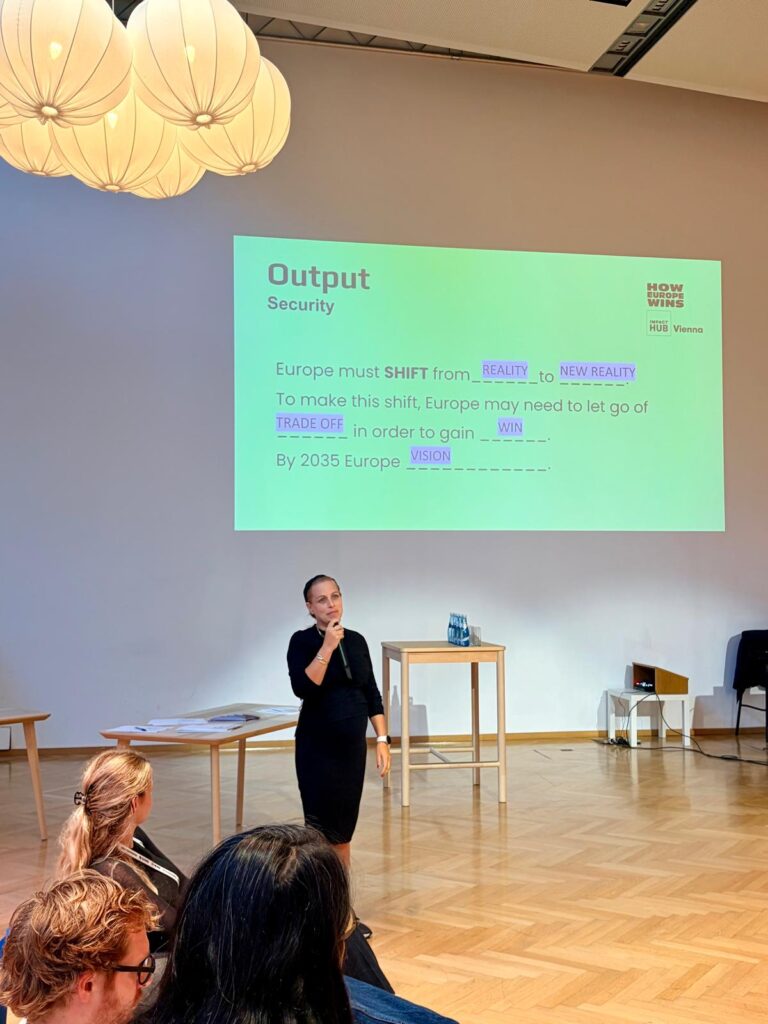
- First, participants identified the necessary shift: What must Europe move away from, and what new logic, capability, or organizing principle should replace it?
- Second, they examined the trade-offs involved in that shift: Who would benefit, and who might bear the cost? Which values or priorities are in conflict? What could be lost as well as gained? What must be protected to ensure that the transition is legitimate and fair? The intention was not to eliminate disagreement or create an artificial consensus. It was to identify the difficult choices that Europe must consciously navigate.
- Third, the participants developed a vision for 2035: How would people’s experiences change? What would European institutions be capable of doing? What new collective capabilities would Europe possess? What visible signs would indicate that the shift had succeeded?
The vision was not intended to be just another list of policies. It was intended to describe a concrete future state.
The results of each Solution Hour were documented in a thematic canvas, compared across the four days, and synthesized into the European Forum Alpbach 2026 Manifesto.
The results: Four proposals for how Europe can succeed
The four thematic statements of the manifesto read:
- SECURITY
For Europe to achieve security, it must move away from national fragmentation, dependency, and fear toward collective agency, interdependence, and an integrated security architecture. This means setting aside national self-interest, rigidity, and perfectionism in favor of adaptability, effective institutions, and courageous action. By 2035, Europe will be able to defend its people and values as a resilient, equal partner for peace.
- FINANCE
For Europe to succeed financially, it must move away from fragmented, risk-averse national markets and short-term thinking toward an integrated financial union designed to foster opportunity, scale, and long-term investment. This means moving away from national solutions and established practices in favor of innovation, adaptability, and shared sovereignty. By 2035, Europe will be a strong global player known for its competitive capital markets and sustainable prosperity.
- CLIMATE
Europe’s climate victory requires a shift from human domination, silos, and linear consumption to interdependence, shared responsibility, and a just circular economy. This means moving away from extractive ownership and technological dependence in favor of ecological awareness, collective action, and faster implementation. By 2035, Europe will thrive on fewer resources and offer a replicable model for a regenerative civilization.
- DEMOCRACY
Europe’s democratic success requires a shift from complacency, resignation, and fragmented action to active participation, collective leadership, and dynamic decision-making. This means setting aside fear, mistrust, and the power to veto in favor of flexibility, cohesion, and political agency. By 2035, Europe will be a sovereign, inclusive democracy whose citizens shape decisions and work together to achieve shared prosperity.
The broader themes linking the manifesto
Taken together, the four statements reveal five patterns that cut across the individual topics.
1. FRAGMENTATION
The first is fragmentation. Whether the challenge is security, financial markets, climate action, or democratic decision-making, Europe’s ability to act is limited when national interests, institutional silos, and isolated approaches take precedence over collective capacity.
2. SOVEREIGNTY
The second is a different understanding of sovereignty. Throughout the manifesto, sovereignty is not equated with isolation or national self-sufficiency. It arises through interdependence, shared responsibility, strong institutions, and the ability to act together.
3. ADAPTABILITY & AGENCY
The third is the need to move from caution and inertia toward adaptability and agency. Risk aversion, short-term thinking, rigidity, resignation, and veto power manifest themselves in various forms across all four themes. Europe’s ability to shape its future depends on replacing these with the confidence and institutional capacity to make decisions and implement them.
4. LETTING GO
The fourth is an honest acknowledgment that transformation requires letting go. Each proposition identifies established interests, habits, forms of ownership, or patterns of behavior that cannot simply be left untouched. The trade-offs are therefore not a footnote to the vision. They are at the heart of the political and societal work required to achieve it.
5. CONNECTING STRENGTH WITH LEGITIMACY
Finally, the four visions link Europe’s external strength with its internal legitimacy. The Europe described here is capable of defending itself and competing on the global stage, but it is also inclusive, democratic, environmentally responsible, and committed to shared prosperity.
The Role of Impact Hub and Its Labs
For me, the process is just as important as the manifesto.
It reflects what we strive to do across Impact Hub Vienna and our Labs: build communities around shared challenges, connect knowledge and diverse perspectives, and create spaces and processes in which dialogue leads to direction and collective intelligence translates into concrete solutions for society.
Complex challenges rarely persist because no one cares about them or because there is no relevant knowledge. More often, knowledge remains scattered, the necessary stakeholders do not come together, disagreements remain hidden, and conversations lack a process through which they can lead to a shared direction and collective action.
Our goal is to provide the necessary infrastructure for solution development.
The broad questions raised by the manifesto take shape in the areas where our communities work every day. At Impact Hub Vienna, we support social entrepreneurs and connect the broader impact community. Through the Climate Lab, the Future Health Lab, and the Education Lab, we bring together the people and organizations working to shape the future of climate, health, and education.
Across all four initiatives, we aim to combine:
- Communities that bring together people with different types of expertise, experience, influence, and agency to address shared challenges.
- Partnerships that enable organizations from different sectors to move beyond individual projects and work together on systemic issues.
- Spaces and processes in which complexity can be explored, disagreement can become productive, and ideas can develop into concrete solutions for society.
The Solution Hours were one example of this role in practice. They also illustrate why we do not view a successful gathering as an end in itself. The key question is what becomes possible because people came together: What did they come to understand differently? What tensions came to light? What direction emerged? And what can institutions, communities, and individuals carry forward?
We are grateful to the European Forum Alpbach for the close and trusting collaboration that made this process possible.
The Forum and the manifesto have provided a shared direction. The next step is to put it into action. This is the work we want to continue through Impact Hub Vienna and its Labs, together with the communities and partners already connected to them and with others who want to contribute.
If you are developing solutions as a social entrepreneur, shaping climate action, rethinking healthcare, or transforming education, we invite you to join us. Our spaces, our communities, and our programs are designed to help turn our shared vision into concrete solutions for a better Austria and a better Europe.
About the Author: Jakob Detering is our Managing Director, leading the portfolio of Impact Hub, Climate Lab, Future Health Lab, and Education Lab. He also serves on the Executive Board of the global Impact Hub network. A recognized impact entrepreneur, organization builder, and leader in systems change, he brings together business, government, and civil society to turn bold ideas into lasting change. Jakob was also a key driving force in transforming the Social Impact Award into the world’s leading community of early-stage social entrepreneurs and brings extensive experience in scaling social ventures and driving systemic change across Europe and beyond.
Stay informed
We’re always on the move! Sign up for our newsletter to stay up to date on new offers and exciting events. Sign up so you don’t miss a thing!