June 2026
How We Work: Real Agency, Clear Roles, and Shared Responsibility
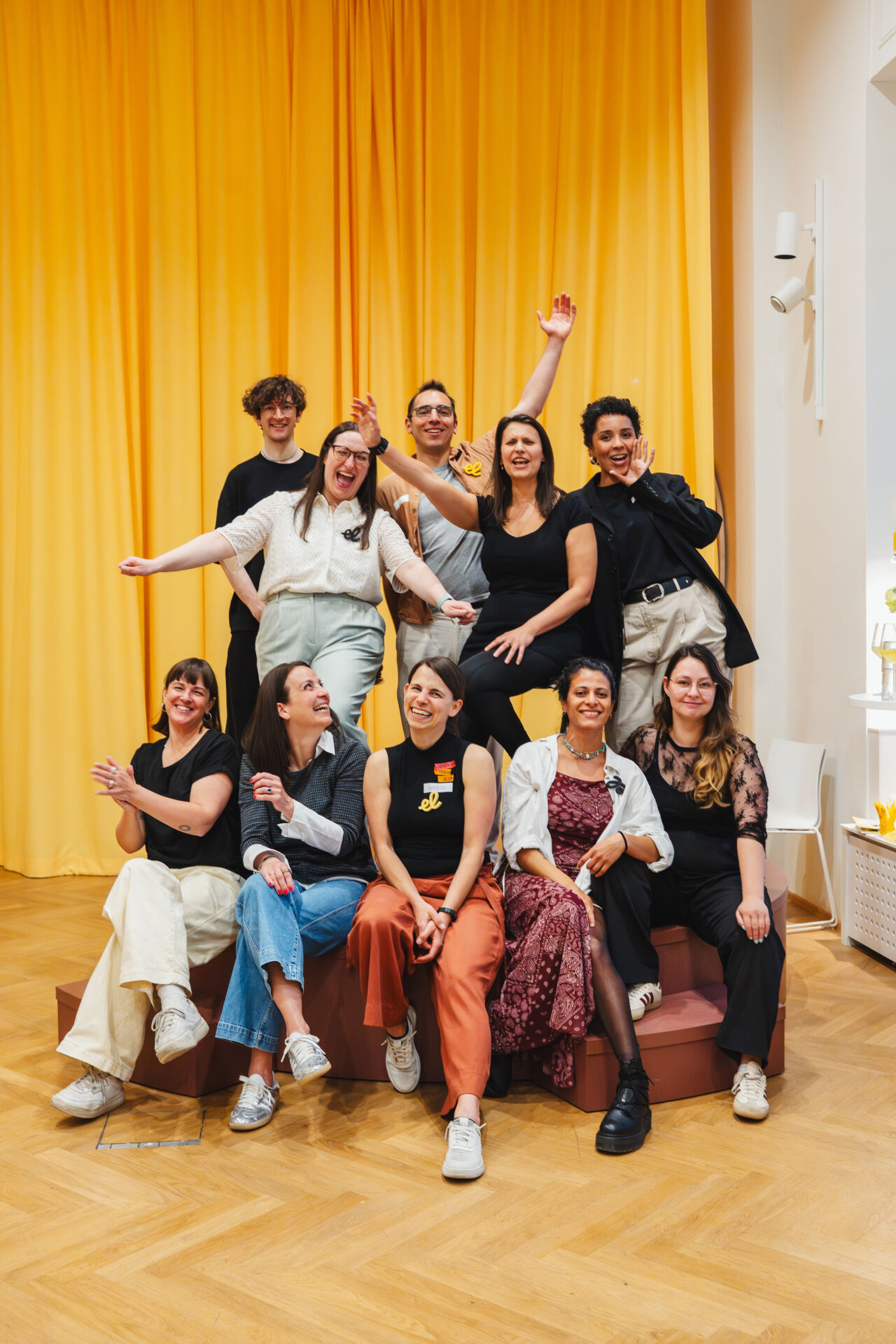
At Impact Hub Vienna —including our Climate Lab, Future Health Lab, and Education Lab —we tackle complex societal challenges: climate transition, social innovation, health, education, entrepreneurship, and systemic change. The work we do is rarely linear. It requires collaboration across disciplines, rapid learning, shared ownership, and the ability to adapt to changing circumstances.
That is why the way we organize ourselves matters. Since 2013, we have been using Holacracy as our operational system. Over the past thirteen years, it has shaped how we distribute authority, define roles, make decisions, and continuously adapt our organization.
We do not operate through a traditional management hierarchy where most decisions must be approved by higher-ups before they can move forward. Instead, Holacracy helps us distribute authority across clearly defined roles and creates transparent processes for changing how the organization works.
For us, Holacracy is not just a buzzword or a cultural experiment. It is a practical answer to a fundamental question: How can people have real autonomy while still working within a clear, accountable, and collaborative structure?
More autonomy does not mean less structure
One of the most common misconceptions about Holacracy is that it means “no hierarchy” or “everyone decides everything together.” That is not how we understand or practice it.
There is still a hierarchy in Holacracy. But the hierarchy is not primarily a hierarchy of people. It is a hierarchy of purpose, roles, and responsibilities. Instead of asking, “Who is your boss?”, the more relevant question is: “Which role has the authority to make this decision?”
This distinction makes a big difference in day-to-day work. An individual may hold several roles across different areas of the organization. Each role comes with a clear purpose, responsibilities, and decision-making authority. Within that role, the individual is trusted to act without having to seek permission from a manager at every step. If something falls within your role, you are expected to take the initiative and move it forward.
This can be highly empowering. It allows colleagues to make decisions close to the work, where the relevant knowledge often resides. It reduces unnecessary bottlenecks. It makes it easier to see who is responsible for what. And it helps us stay entrepreneurial, even as our group has expanded across multiple locations, teams, and fields of work.
At the same time, agency is not the same as unlimited freedom. Holacracy works because authority has boundaries. Roles are clearly defined. Expectations are transparent. And when something is unclear, there are processes in place to clarify it.
Trust: accountability and autonomy
Our way of working is deeply rooted in one of our core values: trust.
For us, trust means accountability combined with autonomy. People are given real responsibility, and they are expected to take ownership of it. They don’t need to ask for permission for every step. They don’t need to wait for someone higher up to approve every decision. They are trusted to act in the best interests of the organization, the team, and the purpose of their role.
But trust is not blind. It is built on clarity, transparency, and reliability. We honor our commitments. We communicate openly. We share information early on. We assume good intentions, even when things get tough. And we give and ask for feedback respectfully.
This is where Holacracy and culture come together. The structure gives people authority. The culture helps them use it effectively.
Roles change as the work changes
In many organizations, job titles remain the same even though the actual work has changed long ago. In our case, we try to make the organization more adaptable.
When a new need arises, a new role can be created. When an existing role no longer reflects reality, it can be modified. When responsibilities are unclear, they can be clarified. This is achieved through governance processes, not through informal politics or behind-the-scenes negotiations.
That means our organizational structure is never completely “finished.” It evolves along with the work.
This is especially important in a group like ours. Across Impact Hub Vienna, Climate Lab, Future Health Lab, and Education Lab, new partnerships are forming, programs are evolving, spaces are expanding, communities are changing, and new strategic priorities are emerging. We need a structure that can adapt to these changes and involve people more flexibly, based on their strengths and contributions rather than their formal positions.
Collaboration: Turning Individual Strengths into Collective Impact
Holacracy is often associated with autonomy. But autonomy only works if it is linked to collaboration.
Our second core value, collaboration, means turning individual strengths into collective impact. We believe that impact arises from the convergence of diverse perspectives: within our team, across our locations, and with our broader ecosystem.
In practice, this means that clearly defined roles should not create silos. They should make collaboration easier. When we know who is responsible for what, we can ask better questions, make clearer requests, and work together with less confusion.
This is especially important across our group. We operate through various locations, legal entities, thematic communities, programs, and partnerships. Our work is interconnected. Holacracy helps us make this complexity more visible and manageable.
It also encourages people to get involved in projects based on the value they can add, not just on their formal position. In practice, this means that someone can contribute because they hold a relevant role, possess a needed skill, have important context, or identify a meaningful issue that needs to be addressed. This makes collaboration more fluid and allows people to apply their strengths in different contexts.
Courage: Speaking Up and Addressing Tensions
The third value that shapes the way we work is courage.
Courage means stepping up —not because it’s easy, but because it matters. In our daily work, this often means speaking up, challenging assumptions, giving honest feedback, or making a decision even when the outcome isn’t entirely clear.
Holacracy provides a practical outlet for this courage. It encourages people to work with “tensions”: the gap between how things are and how they could be improved. A tension does not have to be a conflict. It can be an opportunity, an inefficiency, unclear accountability, a missing role, or a decision that needs to be made.
Instead of waiting for “management” to notice and resolve every issue, we have processes designed to encourage people to bring these tensions to light. That can be uncomfortable. But it is also powerful. It means everyone can contribute to improving the organization.
This is one of the reasons why Holacracy isn’t always easy. It requires people to be active participants in the system, not passive recipients of decisions. It also constantly challenges us to confront our own habits: the temptation to micromanage, to seek consensus when a role could make a decision, or to wait for someone else to take responsibility. Holacracy challenges us day in and day out, which is tough, but it also makes us more resilient, both individually and collectively.
Leadership is everyone’s responsibility
Another misconception is that Holacracy replaces leadership. Our experience shows the opposite: it calls for more leadership, not less.
Leadership is an essential skill for every team member. When authority is distributed across roles, everyone is expected to lead within their area of responsibility: to make decisions, seek input, communicate clearly, manage conflicts, and move work forward without waiting for constant approval.
This does not mean that everyone has the same level of responsibility. People with a broader scope of responsibility still play a crucial role. They need to provide direction, context, feedback, and support. They need to help people grow into their responsibilities, identify where clarity is lacking, where people are overwhelmed, and where the system needs to evolve.
This kind of leadership isn’t always visible in the traditional sense. It’s not about being the final decision-maker for everything. It’s about empowering others to lead from their respective roles.
In that sense, Holacracy does not diminish the need for leadership. It raises the bar. Because when people have more autonomy, leadership becomes even more important: to build trust, strengthen collaboration, and help people act with clarity and responsibility.
We’re still learning, even after thirteen years
Having worked with Holacracy for thirteen years doesn’t mean we’ve “figured it out.”
Implementing and practicing Holacracy is never easy. It is not a system you set up once and then simply let run in the background. It requires ongoing practice, reflection, and adaptation.
This is especially true as we grow. Many team members have joined us at different stages of our journey, which means that experience with Holacracy varies across the organization. Leadership styles differ. Each location develops its own culture, shaped by its team, community, partners, and thematic focus. And the needs of the organization are constantly changing.
So Holacracy remains a learning process. We continually reassess how we use it. We observe where it helps and where it creates friction. We strive to be clearer in our roles, more transparent in our decisions, and more honest in how we handle tensions.
After thirteen years, we do not view Holacracy as a completed achievement. We view it as a practice.
This way of working isn’t for everyone
We strongly believe in this approach to organizing work. But we also want to be honest: Holacracy is demanding.
It requires self-leadership. It calls on people to take responsibility, not only for their tasks, but also for improving the system around them. It requires a willingness to embrace change, because roles and structures can evolve. It requires clear communication, because authority and expectations need to be made explicit. And it requires the courage to address tensions head-on rather than waiting for someone else to resolve them.
For some people, this is energizing. They appreciate the autonomy, transparency, and opportunity to help shape the organization. For others, it can feel unfamiliar or even uncomfortable, especially if they are used to very clear top-down instructions.
That’s okay. We don’t believe that every approach works for everyone.
But for people who want to take ownership, who enjoy learning, who value clarity over status, and who want to contribute beyond the confines of a narrow job description, this way of working can be deeply meaningful.
Why it matters
Ultimately, Holacracy is not the goal. The goal is to build an organization capable of doing meaningful work in a complex world.
We want decisions to be made by the people closest to the work. We want colleagues to feel trusted and accountable. We want collaboration to happen across roles, locations, and disciplines. We want leadership to empower rather than control. And we want people to have the courage to shape the organization they are part of.
This is how we do things differently. Not perfectly. Not without friction. But intentionally.
Because if we want to support entrepreneurs, innovators, and partners in building a more sustainable and inclusive future, we also need to keep asking ourselves how we can build an organization where people can do their best work.
About the Author: Jakob Detering is our Managing Director, leading the portfolio of Impact Hub, Climate Lab, Future Health Lab, and Education Lab. A recognized impact entrepreneur and organization builder, Jakob also has been a key driving force in transforming the Social Impact Award into the world’s leading community of early-stage social entrepreneurs. He brings extensive experience in scaling social ventures and driving systemic change across Europe and beyond.
Stay informed
We’re always on the move! Sign up for our newsletter to stay up to date on new offers and exciting events. Sign up so you don’t miss a thing!